From Local Roots to Global Impact: MMUST Researcher Transforms Local Challenges into Globally Recognized Science
At Masinde Muliro University of Science and Technology (MMUST) in Kakamega County, western Kenya, scientific discovery is not an abstract pursuit. It is deeply intertwined with the realities of food security, public health, and sustainable development. From the agricultural fields of the Lake Victoria basin to research laboratories in Nairobi, Kenyan scientists are demonstrating how locally grounded research can generate knowledge with global relevance.
In today’s interconnected world, sustainable solutions to global challenges; climate change, food insecurity, and emerging diseases must be informed by diverse cultural and ecological contexts. Kenyan universities such as MMUST are increasingly becoming hubs for this kind of context-driven research, as evidenced by the journey of Dr Dennis Ochieno, a Kenyan scientist at MMUST who worked alongside fellow global researchers.As a Senior Lecturer at Masinde Muliro University of Science and Technology, Dr. Dennis Ochieno began investigating banana pests in East Africa with the aim of urgently confronting an everyday problem: banana crops, a staple that is central to food security in countries like Uganda and Kenya. However, what he did not anticipate was that his work would also highlight a larger challenge facing African researchers as they strive to gain visibility in global scientific publishing.
Raised and trained within the agricultural landscapes of Western Kenya, Dr Ochieno understood firsthand the importance of bananas. In Kenya, bananas are cultivated on approximately 70,000 hectares, predominantly by smallholder farmers in the Lake Victoria Basin Counties. They serve not only as a staple food with varieties like Ndizi and Matooke central to local diets, but also as a cultural and economic resource. The crop provides year-round income for families and features prominently in traditional ceremonies across different communities.
During his postgraduate research, Dr Ochieno identified a serious threat to banana production: infestation by the banana weevil (Cosmopolites sordidus) and the burrowing nematode (Radopholus similis). These pests attack the root systems of banana plants, weakening them and often causing entire plantations to collapse. In western Kenya alone, yield losses of up to 90% have been documented in severely infested farms, undermining food security and farmer livelihoods not only in Kenya, but across Uganda, Tanzania, Rwanda and Burundi.
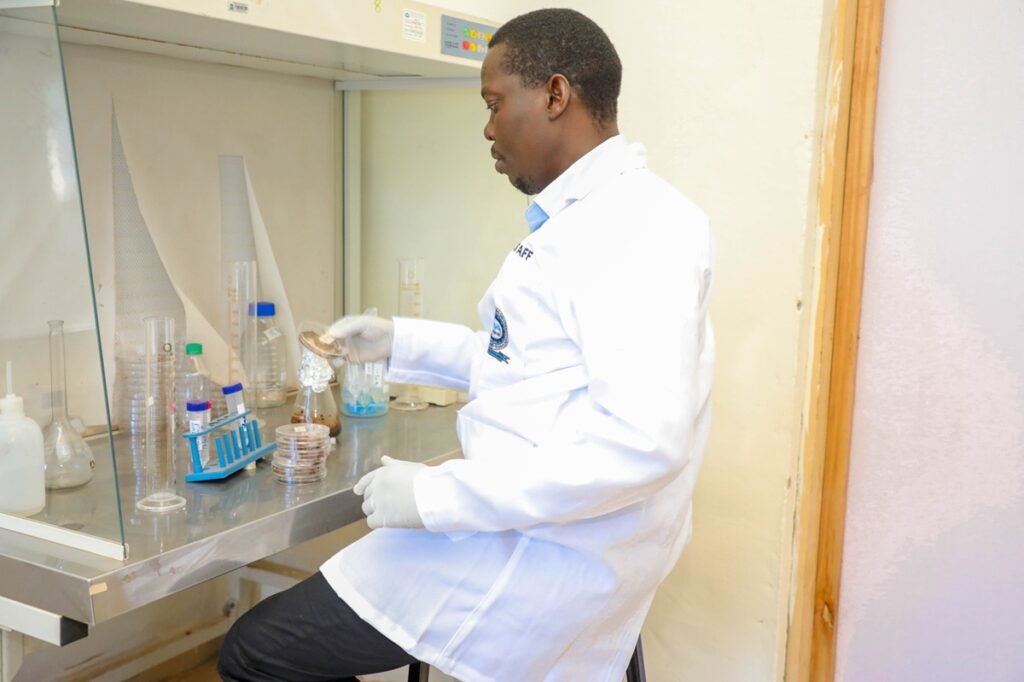
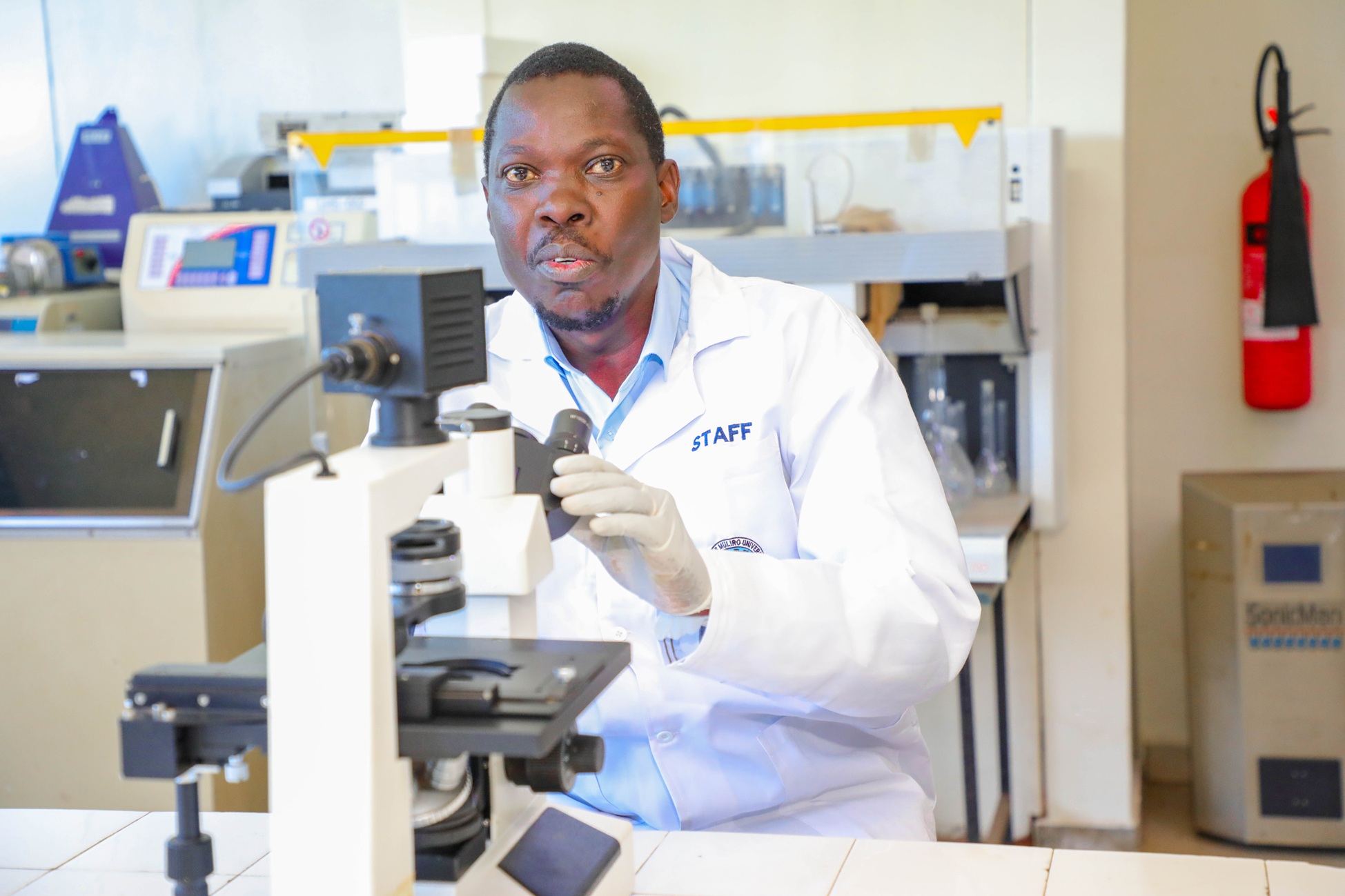
Dr. Dennis Ochieno checking out laboratory products during a laboratory session in Masinde Muliro University of Science and Technology
Motivated by the need for sustainable, farmer-friendly solutions compatible with Kenya’s Vision 2030 goals for food security and agricultural transformation, Dr Ochieno joined a regional research initiative coordinated through the International Institute of Tropical Agriculture (IITA) and involving scientists from Kenya, Uganda, and Tanzania. His doctoral thesis was titled: “Endophytic control of Cosmopolites sordidus and Radopholus similis using Fusarium oxysporum V5w2 in tissue culture banana.”
At the time, Fusarium oxysporum V5w2 was being promoted as a potential biological control agent. However, Dr Ochieno’s rigorous laboratory and field investigations conducted under the agro-ecological conditions revealed a troubling reality: the fungal strain lacked clear taxonomic identity and demonstrated no significant improvement in banana productivity when applied to pest-infested plants under local farming conditions.
Rather than reinforcing prevailing assumptions, his findings challenged them. Dr Ochieno concluded that: Fusarium oxysporum V5w2 should not be registered as a biopesticide in Kenya or the East African region, the fungus should not be transferred to Kenyan and regional farmers and Agricultural research must be grounded in locally validated evidence, tested in a diverse agro-ecological zones, and not based on imported solutions that may fail under African conditions. This stance reflected MMUST’s broader research philosophy and aligned with Kenya’s National Research Priorities: that science must serve communities, not expose them to unproven interventions that could harm smallholder farmers who constitute over 75% of Kenya’s agricultural sector.
Despite the relevance of his findings to East African agriculture and their potential impact on Kenya’s Agricultural Sector Development Strategy, Dr Ochieno faced repeated manuscript rejections from international journals.
“Scientific research is an ethical calling that is based on natural laws and principles. The problems sub-saharan nations are facing emanate from the kind of information we access without judgement and consume without question,” said Dr.Ochieno during an interview.
Like many African scholars and particularly scientists at regional Kenyan universities outside Nairobi, he encountered structural barriers: limited recognition of region-specific studies, skepticism toward negative results, and editorial systems misaligned with Global South research priorities. This challenge is well-documented among researchers at institutions like MMUST, Moi University, and Maseno University, despite their proximity to critical agricultural research zones.
“There needs to be a paradigm shift on how scientific research is governed and implemented in African Universities and research institutions. Decolonizing scientific research and publishing with sustainable funding is the primary step for any development agenda,” emphasized Dr.Ochieno.
Dr.Ochieno’s breakthrough came through Scientific African, a fully open-access, multidisciplinary journal under Elsevier,dedicated to publishing research that addresses Africa’s scientific and development challenges. With encouragement from colleagues and mentors, including collaborators at the Kenya Agricultural and Livestock Research Organization (KALRO) and regional agricultural networks, Dr Ochieno transformed his original thesis into six peer-reviewed articles, four of which were published in Scientific African. These publications now inform agricultural policy discussions at Kenya’s Ministry of Agriculture, pest management strategies taught at Egerton University’s Faculty of Agriculture, and future research across the continent. They also reflect a broader trend in global publishing, where research from the Global South region often struggles to find space in mainstream journals.
Drawing on his publishing experience within reputable open-access journals, Dr.Ochieno continues to help strengthen MMUST’s research culture by promoting best practices that enhance global visibility, credibility, and impact of African scholarship. By grounding research in local realities, Kenyan scientists are not only solving regional problems but also shaping the future of science itself.
As Kenya advances its national research and innovation agenda under Vision 2030, the Science, Technology and Innovation Act of 2013, and alignment with the African Union’s Agenda 2063, institutions like MMUST will continue to play a pivotal role. The recently established Kenya Advanced Institute of Science and Technology (Kenya-AIST) in Konza Technopolis, alongside established research centres like the International Centre of Insect Physiology and Ecology (icipe) in Nairobi, demonstrates Kenya’s commitment to becoming a regional science and innovation hub.
Dr Dennis Ochieno’s research demonstrates that solutions to Kenya’s agricultural challenges and by extension, Africa’s development needs must emerge from Kenyan soil, tested by Kenyan scientists, and validated under Kenyan conditions. His work at MMUST embodies the principle that the best science is science that serves its people.