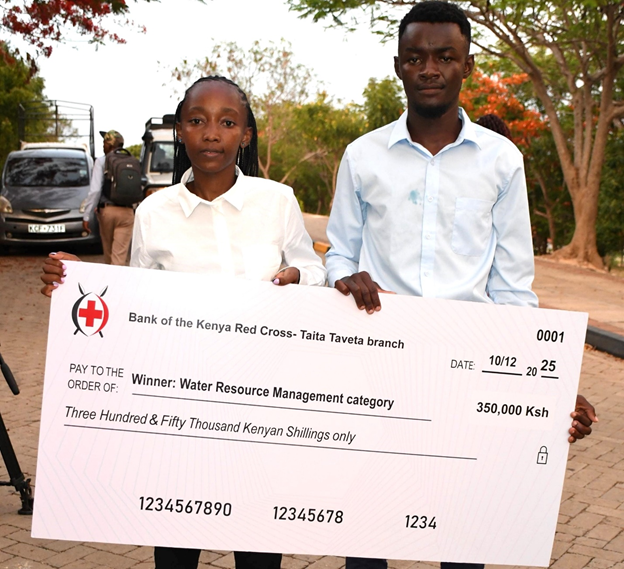
‘Waterlens AI’ Solution by Two SDMHA Students Emerges Top at the AI Innovation Challenge 2025 Held at Taita Taveta University
Two (2) of Masinde Muliro University of Science and Technology’s students from the School of Disaster Management and Humanitarian Assistance (SDMHA) have clinched Kshs. 350,000, courtesy of their ‘WaterLens AI’ solution. This was during the AI Innovation challenge 2025, which was held at Taita Taveta University (TTU) on 10th December, 2025. Mr. Samwel Okongo and Ms. Caroline Kimamo showcased their innovation at the multi-stage competition, aimed at empowering young innovators to develop AI and Machine Learning solutions that address climate change and environmental degradation specifically in Taita Taveta County. The initiative is led by the Kenya Red Cross Society (KRCS), the International Center for Humanitarian Affairs (ICHA), and TTU.
The 2025 AI Innovation challenge focused on three (3) thematic areas, namely Disaster Alert and Response, Agriculture Optimization, as well as Water Resource Management. Samwel and Caroline’s solution emerged top in the Water Resource Management category, following a rigorous evaluation by a panel of judges, who were drawn from academia, the humanitarian sector and the technology industry.
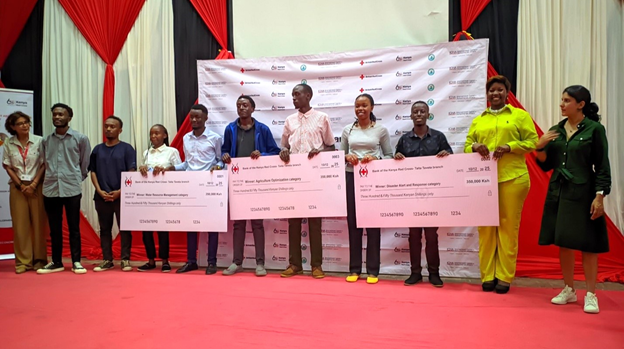
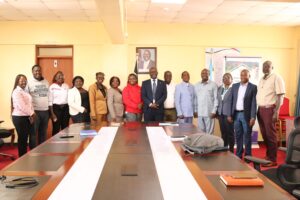
Winners of the AI Innovation challenge 2025 with judges at the event.
WaterLens is an AI-powered water resource monitoring and prediction system, designed to help communities, County authorities, and the Kenya Red Cross to track water sources in real time, identify areas facing water stress, and predict future shortages. The goal is to support faster response, better planning and more sustainable water management across Taita Taveta County. In the challenge, the WaterLens AI innovation was recognized for not just its relevance, but for its potential to strengthen data-driven decision-making in water resource management. Notably, the solution was developed and refined during the prototype phase, which took place between 1st and 28th November, 2025, when the team extensively utilized the MMUST Geographic Information System (GIS) Laboratory to support spatial analysis, data processing and prototype development.
This competition kicked off with a call for applications, attracting innovative ideas from students and technologists across the country. The Call closed on 26th September, 2025 and thereafter, a thorough review process was carried out. Thirty (30) teams were later shortlisted on 1st October, 2025 and advanced to a virtual pitching stage held on 15th October, 2025. Successful teams then participated in an intensive mentorship boot camp, conducted between 27th and 31st October, 2025, where they refined their ideas with guidance from experts in Artificial Intelligence, geospatial science, and humanitarian response.
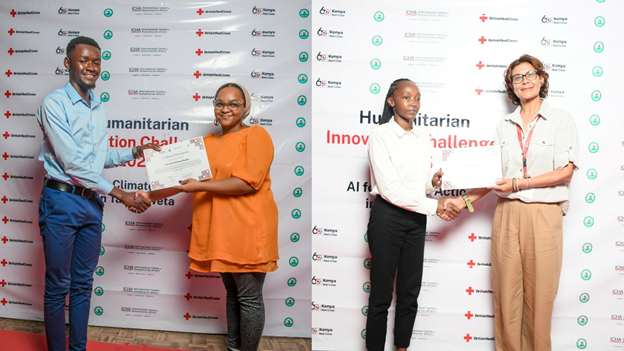
Samwel and Caroline receive certificates of participation during the award ceremony.
It is worth noting that Samwel and Caroline currently serve as the Treasurer and Organizing Secretary respectively in the Geospatial Information Science Students Association (GISSA)-MMUST Chapter. Samwel is also the West Kenya Regional Youth Chairperson. In their University report, the two expressed gratitude to the GISSA Patron and Dean-SDMHA, Dr. Ferdinand Nabiswa. They credited his mentorship and continuous guidance as instrumental in securing the award, and enhancing their overall academic journey. They also acknowledged the support from the Patron of the Kenya Red Cross Society-MMUST Chapter, Dr. Nicodemus Nyandiko, noting that his leadership is a true embodiment of service to humanity.
As AI becomes increasingly integrated into our day-to-day lives, the success of this prototype innovation confirms its power as a tool to elevate humanity, and build a resilient and climate-secure future. Samwel and Caroline are certainly among the young innovators utilizing AI to come up with solutions that will help the community and the world at large.