MMUST And IFBA Sign Phase 3 Agreement For Continued Delivery And Sustainability Of The Bachelor Of Science In Biosafety & Biosecurity Program
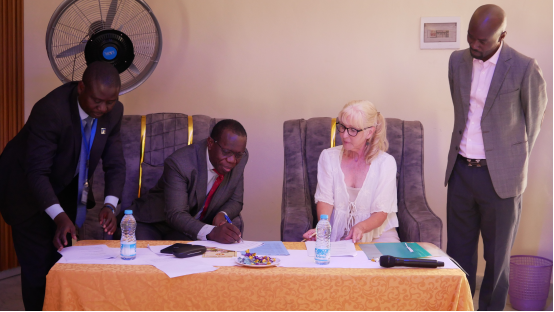
Masinde Muliro University of Science and Technology and the International Federation of Biosafety Associations (IFBA) have officially signed a phase 3 Agreement to support the continued delivery and sustainability of the Bachelor of Science in Biosafety & Biosecurity program. The phase 3 Agreement was signed by the Vice Chancellor, Prof. Solomon Shibairo and Ms. Maureen Ellis, the IFBA-MMUST Project Specialist. The signing was undertaken during a Workshop, themed Mitigating Modern Biosecurity Threats in East Africa, which took place at the Golf Hotel Kakamega-Kenya from 24th to 25th February 2026.
This Agreement builds on the success of the program’s initial years and reinforces the shared commitment of MMUST and IFBA to advancing biosafety and biosecurity education in Africa. It marks a significant milestone as the program enters Years 3 and 4, focusing on graduating the first cohort of students, strengthening institutional capacity, and laying the foundation for long-term sustainability and regional expansion across Africa.
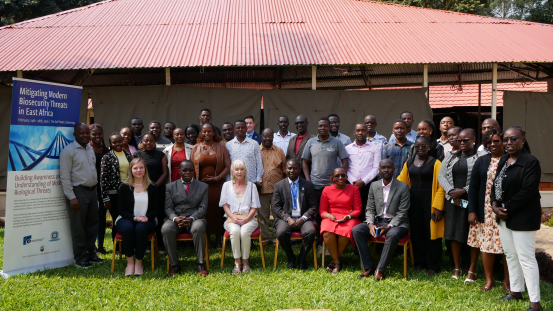
Workshop participants at the Golf Hotel Kakamega-Kenya.
It is anticipated that the Agreement will strengthen program delivery through targeted faculty capacity building, engagement of guest lecturers and bench-marking. The Agreement will boost institutional exchange with the University of British Columbia, and enhance focused professional development aligned with emerging biological threat priorities. Phase 3 also places strong emphasis on program sustainability and future expansion.
The hallmark of the BSc. Biosafety & Biosecurity program is its experiential learning and co-op placements within relevant laboratory and research settings in Kenya and Tanzania. Phase 3 strengthens this approach with student rotations at the Africa CDC Regional Centre of Excellence for Biosafety & Biosecurity (RCoEBB) housed within the National Public Health Laboratory in Dar es Salaam, as well as ongoing collaboration with the Biorisk Management Association of Kenya (BMAK) and the Tanzania Biological Safety Association (TaBSA).
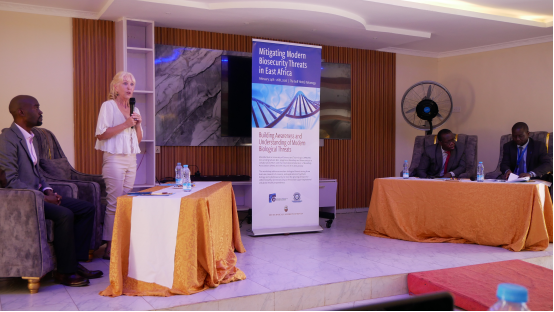
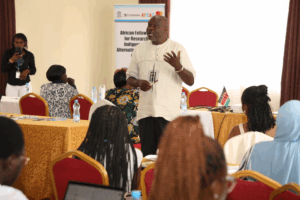
Ms. Maureen Ellis speaks at the Workshop.
The BSc. Biosafety & Biosecurity program at MMUST remains the first of its kind globally, formalizing a critical professional pathway within higher education. Through this continued partnership, MMUST and IFBA reaffirm their shared commitment to developing skilled professionals equipped to manage biological risks, strengthen laboratory systems, and contribute to national, regional, and global health security.
The signing of the Phase 3 Agreement signals a strong and sustained commitment to graduating the first cohort and ensuring the long-term success and scalability of this pioneering program.
By Dr. Lydia Anyonje and Wangari Wambugu