
MMUST Scholars And Partners Validate New Training Manual For County Health-Care Workers Ahead Of The Implementation Of 370,000 Euros Sickle Cell Disease Funded Project!
In an effort to reduce under-five mortality rates, scholars from Masinde Muliro University of Science and Technology, in collaboration with the County Government of Kakamega, and DAMKA, on 5th March, 2025, moved to validate a new training manual for health-care workers in Kakamega County. This was in preparation for the implementation of the 370,000 Euros Sickle Cell Disease funded project, titled, ‘Saving Newborn Lives Through Point-of-Care Early Diagnosis of Sickle Cell Disease in Kenya’. The manual will aid in training over 4200 health-care workers across 21 local health facilities in the County.
Speaking during the validation exercise, the Ag. Deputy Vice Chancellor-Planning, Research and Innovation, Prof. Peter Bukhala delivered a candid assessment of the current status of research in the institution and County. He encouraged researchers from the University and the County to work together and synergize their efforts. “We are duplicating facilities and equipment, which are not being used to their maximum capacity. We must think bigger and integrate our resources within Kakamega County. This is the only way we will begin to see the true impact of our work as researchers,” said Prof. Bukhala.

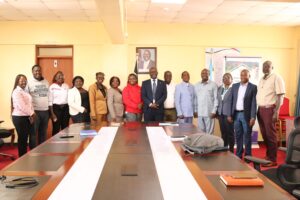
The Ag. Deputy Vice Chancellor-Planning, Research and Innovation, Prof. Peter Bukhala with members from the County Government of Kakamega.
Beyond physical resources, Prof. Bukhala challenged researchers to stop ‘starting from zero’ and instead, build upon existing data. He noted that, while the region has multiple data points, from various research activities, the findings have never been unified, leading to a cycle of repetitive research with no progress. “Research should always be working on the next step, rather than re-investigating what we already know. I encourage all of us to look at our collective research capacities so that we can move our activities to the next level of intervention,” he added.
Reiterating Prof. Bukhala’s sentiments, the Director Research and Postgraduate Support, Prof. Francis Orata proposed the establishment of a Sickle Cell Research and Training Centre of Excellence in Kakamega. “MMUST has the capacity to host such a Centre, which will serve as a hub for data collection, advanced treatment and interventions, as well as diagnostic skills in SCD,” he stated.

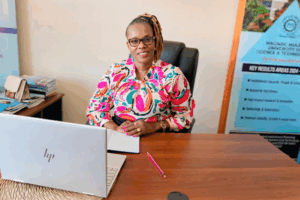
The Director Research and Postgraduate Support, Prof. Francis Orata (left);County Chief Officer for Medical Services, Dr. David Alila and Ms. Rose Muhanda, the Chief Officer for Public Health in Kakamega County, at the event.
Prof. Constance Tenge, the Director Federation of Sickle Cell Disease in Kenya, commended Kakamega for being the first county to unite SCD stakeholders in such a structured manner. “It has been the Federation’s dream for every county to develop a tailored Sickle Cell control strategy. By bringing everyone to the table, Kakamega is now leading the nation,” remarked Prof. Tenge.
Dr. Beatrice Mukabane, the Principal Investigator in the Project, appreciated her Co-PIs Dr. Roselyn Abwalaba and Dr. Edward Khasakhala for their commitment towards the development of the SCD Manual. She also noted the efforts of the Project’s Data Manager, Mr. Noah Wamukoya and the entire DAMKA and County team. “ The manual will be beneficial to the children of this County. With the potential to roll out to other counties, the plan is to have 30,200 newborns screened and started on care for SCD immediately under the team’s observation,” she explained.
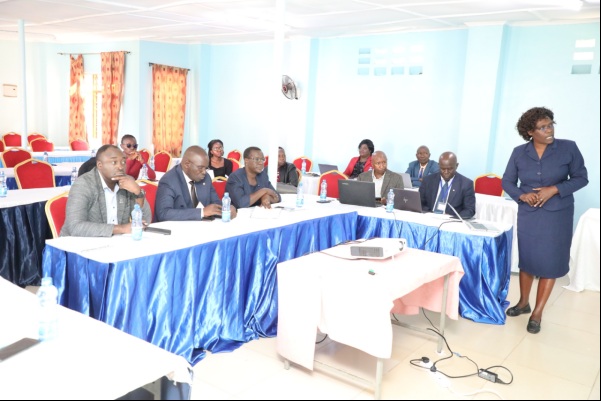
Dr. Beatrice Mukabane, the Principal Investigator in the Project makes a presentation.
Dr. Edward Khasakala, one of the Co-PIs in the Project pointed out that the manual will be useful in training health-care workers and Community Health Promoters in the entire region. Equally, Dr. Roselyn Abwalaba, also a Co-PI in the Project said that such standardization of approaches to managing the SCD, will go a long way in tackling a challenge that health practitioners have been grappling with.
Ms. Rose Muhanda, the Chief Officer for Public Health in Kakamega County lauded the consortium for its proactiveness to local health challenges. Addressing the regional context, she noted that while neighbours like Uganda have already implemented mandatory screening, Kakamega is now on the right path. “We have to start somewhere, and I am confident that we will reach the level of mandatory care. We will support this, especially regarding community engagement,” she added.

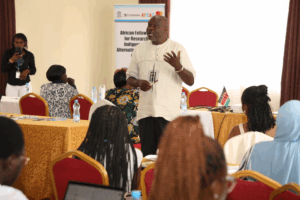
Prof. Constance Tenge, the Director Federation of Sickle Cell Disease in Kenya addresses the participants.
The County Chief Officer for Medical Services, Dr. David Alila called for the development of a formal policy to standardize the management of the disease. “As we go into this research, we must address the reality that Sickle Cell has become a stigma in our communities, much like cancer and other chronic conditions. This social aspect must be addressed strongly within the training manual to ensure patients are treated with dignity,” he observed.
Further, Dr. Alila spoke of the need for a close partnership between MMUST and the County Government. “MMUST possesses high-level expertise required at our hospitals, and vice versa. By collaborating, they can reactivate our internal county research teams. I am fully committed to providing the space and administrative support necessary to make this partnership a success,” he affirmed.
Undoubtedly, validation of the SCD manual will transform the 21 facilities earmarked by the Project. Indeed, this Project has achieved not just the construction of a frontline defense against the disease that has claimed too many young lives in Western Kenya but, established a pool of top-notch experts in Sickle Cell Disease management.
By Dr. Lydia Anyonje and Caren Nekesa
Photos by Shiundu Masafu